









Most words in Arabic can be traced to a tri-consonantal root, consisting of three consonants, called radicals, used to form word patterns. Only a few words can be traced to roots with two or four radicals. This is a characteristic feature of Arabic and other Semitic languages, such as Amharic, Hebrew, and Aramaic.
In a consonantal root system, consonants are the main carriers of meaning, whereas vowels, prefixes, suffixes, infixes, etc., modify that word while maintaining some relationship with the original meaning implied by the consonantal root.
Let us illustrate this with an example.
Take the consonantal root ك – ت – ب (k – t – b), which is used to derive the following words in Palestinian-Jordanian Arabic:
| _ a _ a _ | كَــتَـب | katab | he wrote |
| bu _ _ u _ | بُـكْــتُــب | buktub | he writes |
| _ _ ā _ | كْــتَـاب | ktāb | book |
| _ u _ u _ | كُــتُـب | kutub | books |
| ma _ _ a _ | مَـكْــتَـب | maktab | desk/office |
| ma _ _ ū _ | مَـكْــتُـوْب | maktūb | written |
| _ ā_i_ | كــاتِـب | kātib | writer |
Notice that words derived from the same consonantal root often share related meanings. For instance, a ‘book’ is something that is written, whereas an ‘office’ is where the writing occurs. This is how word derivation works in Arabic.
Here is another example of words derived from the consonantal root ر – س – ل (r – s – l):
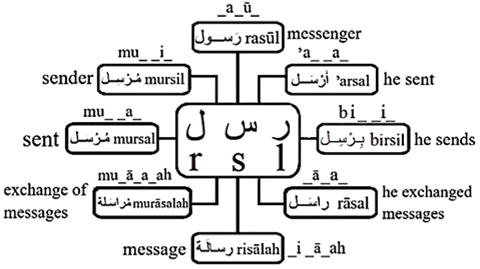
Finding the root of a word is not always straightforward. It requires practice and a deep understanding of the language’s intricacies. Determining the consonantal root is also crucial when using a traditional Arabic dictionary. In Arabic, unlike in English, words are searched using their consonantal roots rather than their alphabetical order in a dictionary. For example, to search for the word مَـكْــتُـوْب (maktūb) ‘written’ in Arabic, you will need to search for the root ك – ت – ب (k – t – b).
In Arabic morphology, the tri-consonantal root ف – ع – ل (f – ‘ – l) serves as a template to illustrate how different word patterns are formed:
ف (f) – Represents the first radical of a root.
ع (‘) – Represents the second radical of a root.
ل (l) – Represents the third radical of a root.
The simplest verb derived from this root is فَــعَـل (fa‘al), meaning ‘he did or acted.’ Note that in Arabic, the simplest (or base) verb form is the third-person singular masculine past tense.
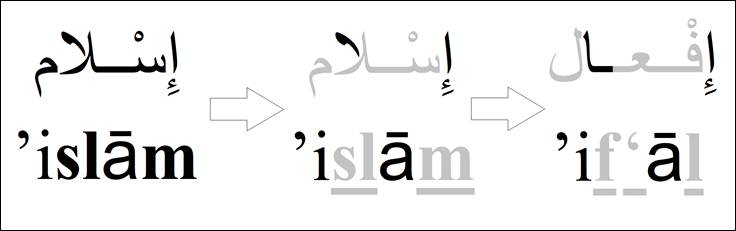
For example, the word إِسْــلام (’islām) ‘Islam’ is derived from the consonantal root س – ل – م (s – l – m). Thus, we conclude that the word إِسْــلام (’islām) ‘Islam’ follows the pattern (’i◌◌ā◌). The literal meaning of the word Islam is submission, referring to the act of submission to God. By recognizing that the consonantal root is س – ل – م (s – l – m), we deduce that the word إِسْــلام (’islām) ‘Islam’ follows the pattern إِفْــعـال (’if ‘āl).
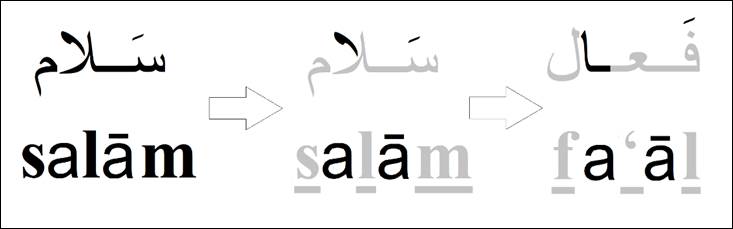
Another word derived from the consonantal root س – ل – م (s – l – m) is the noun سَــلام (salām) ‘peace.’ By following the same exercise, we deduce that the word سَــلام (salām) ‘peace’ follows the pattern فَــعـال (fa‘āl).
Notice that there are often many patterns available to derive words from a consonantal root. Some of the words following these patterns are still used by native speakers today, whereas others are not—some may have been used historically but are no longer in use.
Let us continue with the consonantal root س – ل – م (s – l – m) and consider the most common possible past verb patterns, also known as verb forms, in the third-person singular masculine form.
The ten most common past verb forms in Arabic are:
| I | II | III | IV | V |
| فـعـل fx‘xl | فَـعَّـل fa‘‘al | فَـاعَـل fā‘ al | أَفْـعَـل ’af ‘ al | تْـفَـعَّــل tfa‘‘ al |
| VI | VII | VIII | IX | X |
| تْـفَـاعَـل tf ā ‘ al | اِنْـفَـعَـل infa‘al | اِفْـتَـعَـل ifta‘al | اِفْـعَـلّ if ‘ all | اِسْـتَـفْـعَـل istaf ‘al |
Form Legend:
I. Base Form
II. Intensive, Causative, or Transitive
III. One-sided Attempts
IV. Causative V. Reflexive of II
VI. Reflexive of III
VII. Passive of I
VIII. Reflexive of I
IX. Colors & Deformities
X. Causative Reflexive
By replacing the radicals in the template root ف – ع – ل (f – ‘ – l) with the radicals س – ل – م (s – l – m), we derive the following verbs:
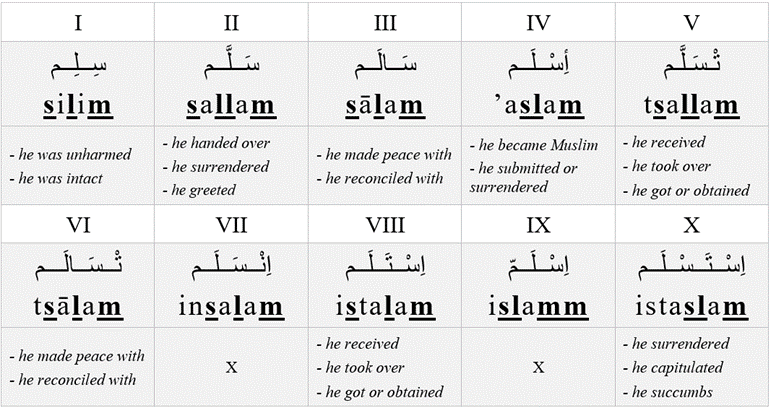
Notice the variety of meanings conveyed by the patterns and their relationships. Sometimes the relationship can be logical—for example, submitting or surrendering to attain peace. However, the meaning may also deviate, making the relationship vague or obscure. This process of unraveling the root derivation and the evolution of meaning is an intriguing feature of Arabic. Additionally, note that some of these patterns may not apply to certain consonantal roots.
It is important to be able to recognize the root of a word for two main reasons. First, only by recognizing the consonantal root of a word can you access a traditional Arabic dictionary. For more complicated words, this may take a few educated guesses. Second, many word patterns appear in verb conjugation and other derivations, such as irregular plural formation, diminutives, etc., which can help you recognize and form new words.
Moreover, some everyday Palestinian-Jordanian and Levantine words may not be found in an MSA dictionary. Some of these words came from other languages, such as Aramaic, Turkish, and English.
Next: The Definite Article الـ (il)
Other lessons in Level I: