






In this lesson, we cover the past tense in Palestinian-Jordanian Levantine Arabic, also known as the perfect tense, which corresponds to the English past or present perfect tense.
Tenses in Arabic
In terms of moods and verbal tenses, Arabic can be seen as simpler than many Indo-European languages, including English. In general, Arabic grammarians divide tenses into only two main categories:
- الـزَّمَـن الـمـاضـي (az-zaman al-māḍī) ‘the past tense,’ which corresponds to the English past or present perfect tense.
- الـزَّمَـن الـمُـضـارِع (az-zaman al-muḍāri‘) ‘the present tense,’ which often corresponds to the English present or present continuous tense.
Note that in some Arabic grammar books for English learners, the past tense and present tense are sometimes referred to as the perfect tense and imperfect tense, respectively.
Some verbal tenses found in English do not exist in Arabic. Arabic verbs do not have an infinitive form. The consonantal root in Arabic is somewhat comparable to the infinitive in Indo-European languages but serves a distinct role. The future tense is derived directly from the present tense, as will be explained in Level III, Lesson 1.
In this lesson, we will examine الـزَّمَــن الـمـاضـي (iz-zaman il-māḍi) ‘the past tense.’ A verb used in the past tense is referred to as فِـــعْـــل مَــاضِــيْ (fi‘l māḍi) ‘past verb.’
Basic Forms of Triliteral Past Verbs
Most verbs in Arabic have tri-consonantal roots, while only a few verbs have quadri-consonantal roots.
Let us first examine the two base forms of past verbs used in Palestinian-Jordanian Arabic. Base verb forms are constructed from the three radicals of the tri-consonantal root without prefixes, suffixes, or infixes. We call this a base verb form, or مُـجَـرَّد ثُـلاثـي (mujarrad thulāthī) ‘triliteral abstract.’
The key difference between the two base verb forms in Palestinian-Jordanian Arabic is the short vowels that mark the first and middle radicals.
| I-A فَـعَـل fa‘al | I-B فِـعِـل fi‘il |
| كَـتَـب katab he wrote | شِــرِب shirib he drank |
| فَـتَـح fataḥ he opened | كِـبِــر kibir he/it grew or became bigger |
| دَرَس daras he studied | نِـــزِل nizil he went down |
Past-tense verb conjugation varies by gender and number. To conjugate a verb in the past tense, the appropriate attached pronoun (suffix) is added to the stem فـعـلـ (fx1‘x2l-), where the two vowels “x1” and “x2” are set based on the two different vocalization patterns of the base forms discussed above.
| Singular | Plural | |
| 1st person (m/f) | أَنَــا فَــعَــلْــت/فْــعِــلْــت ’ana fa‘alt/f‘ilt I did | إِحْــنَــا فَــعَــلْــنَــا/فْــعِــلْــنَــا ’iḥna fa‘alna/f‘ilna We did |
| 2nd person masculine | إِنْــتَ فَــعَــلْــت/فْــعِــلْــت ’inta fa‘alt/f‘ilt You did | إِنْــتُــوْ فَــعَــلْــتُــوْ/فْــعِــلْــتُــوْ ’intu fa‘altu/f‘iltu You (all) did |
| 2nd person feminine | إِنْــتِ فَــعَــلْــتِ/فْــعِــلْــتِ ’inti fa‘alti/f‘ilti You did | إِنْـتِـنْ فَــعَــلْــتِــن/فْــعِــلْــتِــن ’intin fa‘altin/f‘iltin You (all) did |
| 3rd person masculine | هُــوِّ فَــعَــل/فِــعِــل huwwe fa‘al/fi‘il He did | هُــمِّ فَــعَــلُــوْ/فِــعْــلُــوْ humme fa‘alu/fi‘lu They did |
| 3rd person feminine | هِــيِّ فَــعْــلَــت/فِــعْــلَــت hiyye fa‘lat/fi‘lat She did | هِــنِّ فَــعَــلِــن/فِــعْــلِــن hinni fa‘alin/fi‘lin They did |
Consider the following two examples of base verb forms:
- The verb كَـتَـب (katab) ‘he wrote,’ following the base form I-A فَـعَـل (fa‘al), is conjugated as follows:
| Singular | Plural | |
| 1st person (m/f) | أَنَــا كَــتَــبْــت ’ana katabt I wrote | إِحْــنَــا كَــتَــبْــنَــا ’iḥna katabna We wrote |
| 2nd person masculine | إِنْــتَ كَــتَــبْــت ’inta katabt You wrote | إِنْــتُــوْ كَــتَــبْــتُــوْ ’intu katabtu You (all) wrote |
| 2nd person feminine | إِنْــتِ كَــتَــبْــتِ ’inti katabti You wrote | إِنْـتِـنْ كَــتَــبْــتِــنْ ’intin katabtin You (all) wrote |
| 3rd person masculine | هُــوِّ كَــتَــب huwwe katab He wrote | هُــمِّ كَــتَــبُــوْ humme katabu They wrote |
| 3rd person feminine | هِــيِّ كَــتْــبَــت hiyye katbat She wrote | هِــنِّ كَــتَــبِــن hinni katabin They wrote |
- The verb شِــرِب (shirib) ‘he drank,’ following the base form I-B فِـعِـل (fi‘il), is conjugated as follows:
| Singular | Plural | |
| 1st person (m/f) | أَنَــا شْـــرِبْــت ’ana shribt I drank | إِحْــنَــا شْـــرِبْـــنَـــا ’iḥna shribna We drank |
| 2nd person masculine | إِنْــتَ شْـــرِبْــت ’inta shribt You drank | إِنْــتُــوْ شْـــرِبْـــتُـــوْ ’intu shribtu You (all) drank |
| 2nd person feminine | إِنْــتِ شْـــرِبْــتِ ’inti shribti You drank | إِنْـتِـنْ شْـــرِبْـــتِــن ’intin shribtin You (all) drank |
| 3rd person masculine | هُــوِّ شِـــرِب huwwe shirib He drank | هُــمِّ شِـــرْبُـــوْ humme shirbu They drank |
| 3rd person feminine | هِــيِّ شِـــرْبَــت hiyye shirbat She drank | هِــنِّ شِـــرْبِـــن hinni shirbin They drank |
Here are some examples in context:
| .كَــتَــبْــت رِسَــالِــة لَــصَــاحْــبِــيْ katab(i)t risāleh la-ṣāḥbi I wrote a letter to my friend. | .إِحْــنَــا شْـرِبْـــنَـا الْـعَــصِــيْــر ’iḥna shribna -l-‘aṣīr We drank the juice. |
| .أَحْــمَــد فَـــتَـــح اِلْــبَــاب ’aḥmad fataḥ il-bāb Ahmad opened the door. | .اِلْاَوْلَاد كِــبْــرُوْ بْــسُــرْعَــة il-awlād kibru b-sur‘ah The boys grew up quickly. |
Note that the detached personal pronoun may be omitted, since the verb conjugation ending often suffices to indicate the subject.
When describing non-human beings—such as animals, plants, objects, or concepts—in the plural, we use either the feminine singular or the plural form.
| .كِــثْــرَت/كِــثْــرُوْ اِلْــمَــشَــاكِــل kithrat/kithru il-mashākil The problems increased. | .اِلْــبِــسَــس شِــرْبَــت/شِــرْبُــوْ اِلْــمَــيِّــة il-bisas shirbat/shirbu il-mayyeh The cats drank the water. |
Depending on the dialect variant, some Palestinians make the distinction between genders to refer to all-female groups in the second- and third-person plurals, whereas many others use the masculine pronoun to refer to both male and female groups.
| .اِلْاَوْلَاد كِــبْــرُوْ بْــسُــرْعَــة il-awlād kibru b-sur‘ah The boys grew up quickly. | .اِلْــبَــنَــات كِــبْــرُوْ/كِــبْــرِن بْــسُــرْعَــة il-banāt kibru/kibrin b-sur‘ah The girls grew up quickly. |
Thus far, we have focused on verbs that do not contain ا (a), و (w), or ي (y) in their base forms. Verbs that contain these radicals in their roots will be covered in more detail in Level VI, Lesson 2 on irregular verbs.
Derived Triliteral Past Verb Forms
In addition to the base verb forms, derived forms modify the triliteral root in various ways, such as doubling a consonant, lengthening a vowel, or inserting a prefix, infix, or suffix.
The ten most common past verb forms in Palestinian-Jordanian Arabic are:
| I | II | III | IV | V |
| فـعـل fx‘xl | فَـعَّـل fa‘‘al | فَـاعَـل fā‘ al | أَفْـعَـل ’af ‘ al | تْـفَـعَّــل tfa‘‘ al |
| VI | VII | VIII | IX | X |
| تْـفَـاعَـل tf ā ‘ al | اِنْـفَـعَـل infa‘al | اِفْـتَـعَـل ifta‘al | اِفْـعَـلّ if ‘ all | اِسْـتَـفْـعَـل istaf ‘al |
Form Legend:
I. Base Form
II. Intensive, Causative, or Transitive
III. One-sided Attempts
IV. Causative V. Reflexive of II
VI. Reflexive of III
VII. Passive of I
VIII. Reflexive of I
IX. Colors & Deformities
X. Causative Reflexive
The general features of the ten verb forms are as follows:
I. فَــعَــل (fa‘al) / فِــعِــل (fi‘il)
This is the base verb form constructed from the three radicals of the tri-consonantal root without any modifications.
Verbs in the basic form can have a wide range of meanings, transitive or intransitive.
II. فَــعَّــل (fa‘‘al)
This verb form is marked by doubling the second radical.
Verbs in Form II often convey intensive, causative, or transitive meaning of the base form I.
| I | ==> | II | |
| كَــسَــر kasar he broke | ==> | كَــسَّــر kassar he smashed | — intensive |
| خِـرِب khirib it got ruined | ==> | خَــرَّب kharrab he ruined | — causative |
| خِــبِــر khibir he knew | ==> | خَـبَّـر khabbar he informed | — transitive |
III. فَــاعَــل (fā‘al)
This verb form is marked by the insertion of a ‘long ā’ vowel after the first radical.
Verbs in Form III often convey a one-sided meaning of attempt or endeavor of the base form.
| I | ==> | III |
| قَــتَــل qatal he killed | ==> | قَــاتَــل qātal he fought |
| دَفَـــع dafa‘ he pushed | ==> | دَافَـــع dāfa‘ he defended |
| سَــبَــق sabaq he preceded | ==> | سَــابَــق sābaq he raced |
IV. أَفْــعَــل (’af‘al)
This verb form is marked by the prefix أَ (’a) before the first radical.
Verbs in Form IV often convey a causative meaning of the base form.
| I | ==> | IV |
| دَخَـــل dakhal he entered | ==> | أَدْخَـــل ’ad khal he inserted |
| نِــزِل nizil he descended | ==> | أَنْـــزَل ’anzal he brought down |
| حَـضَـر ḥaḍar he attended | ==> | أَحْــضَــر ’aḥḍar he brought |
This form is not as common in Levantine dialects as in MSA. Only a few verbs appear in Palestinian-Jordanian daily speech, such as أَعْــطَــى (’a‘ṭa) ‘he gave’ and أَسْــلَــم (’aslam) ‘he became Muslim.’
V. تْــفَــعَّـــل (tfa‘‘al)
This verb form is marked by the prefix ت (t) before the first radical and doubling the second radical.
Verbs in Form V convey a reflexive meaning of Form II, i.e., the action expressed in Form II is done to oneself.
| II | ==> | V |
| حَــضَّــر ḥaḍḍar he prepared | ==> | تْـحَـضَّـر tḥaḍḍar he prepared himself |
| حَــسَّــن ḥassan he made better | ==> | تْـحَــسَّــن tḥassan he became better |
| سَــلَّــم sallam he delivered | ==> | تْــسَــلَّــم tsallam he received |
VI. تْــفَــاعَــل (tfā‘al)
This verb form is marked by the prefix ت (t) before the first radical and insertion of a ‘long ā’ vowel after the second radical.
Verbs in Form VI convey a reflexive meaning of Form III, i.e., denoting reciprocity between two parties of the action expressed in Form III.
| III | ==> | VI |
| قَــاتَــل qātal he fought | ==> | تْــقَــاتَــل tqātal he fought |
| سَــابَــق sābaq he raced | ==> | تْــسَــابَــق tsābaq he raced |
| سَــاءَل sā’al he interrogated | ==> | تْــسَــاءَل tsā’al he wondered |
English translations sometimes cannot reflect certain nuances. For example, the verb قَــاتَــل (qātal) of Form III and the verb تْــقَــاتَــل (tqātal) of Form VI are translated as ‘he fought.’ However, Form III of the verb conveys a one-sided initiation of the fight, whereas Form VI denotes a two-sided fight.
VII. اِنْــفَــعَــل (infa‘al)
This verb form is marked by the prefix اِنْــ (in) before the first radical.
Verbs in Form VII convey a reflexive passive meaning of Form I, i.e., denoting the result of the action expressed in Form I.
| I | ==> | VII |
| كَــسَــر kasar he broke | ==> | اِنْــكَــسَــر inkasar it was broken |
| غَــسَــل ghasal he washed | ==> | اِنْــغَــسَــل inghasal it was washed |
| فَــتَــح fataḥ he opened | ==> | اِنْــفَــتَــح infataḥ it was opened |
This is the most common form used in the everyday Palestinian-Jordanian dialect to express the passive voice.
VIII. اِفْــتَــعَــل (ifta‘al)
This verb form is marked by the prefix اِ (i) before the first radical and the infix ت (t) after the first radical.
Verbs in Form VIII mostly convey a reflexive meaning of Form I, which can be active or passive.
| I | ==> | VIII |
| رَفَـــع rafa‘ he raised | ==> | اِرْتَــفَــع irtafa‘ he/it rose |
| غَــسَــل ghasal he washed | ==> | اِغْــتَــسَــل ightasal he washed himself |
| فَــتَــح fataḥ he opened | ==> | اِفْــتَــتَــح iftataḥ he inaugurated |
Whereas Form VIII denotes the result of the action expressed in Form I, which is similar to that of Form VII, it can also denote an active meaning of the action.
Compare اِغْــتَــسَــل (ightasal) ‘he washed himself’ of Form VIII with اِنْــغَــسَــل (inghasal) ‘it was washed’ of Form VII, both derived from the base verb form غَــسَــل (ghasal) ‘he washed.’
This verb form is marked by the prefix اِ (i) before the first radical and doubling the third radical.
IX. اِفْــعَــلّ (if‘all)
Verbs in Form IX convey the meaning of change in color or in physical trait, especially those referring to deformities.
| Color or Deformity | ==> | IX |
| أَحْــمَــر ’aḥmar red | ==> | اِحْــمَــرّ iḥmarr it became red |
| أَخْـضَـر ’akhḍar green | ==> | اِخْــضَــرّ ikhḍarr it became green |
| أَعْـــوَج ’a‘waj crooked | ==> | اِعْـــوَجّ i‘wajj it became crooked |
This verb form is very rare in both MSA and Levantine dialects.
X. اِسْــتَــفْــعَــل (istaf‘al)
This verb form is marked by the prefix اِسْـتَـ (ista) before the first radical.
Verbs in Form X convey a meaning of request, estimation, or seeking of something.
| I: خَــدَم khadam he served | ==> | X: اِسْــتَــخْــدَم istakhdam he used |
| II:فَــسَّـر fassar he explained | ==> | X: اِسْتَـفْـسَر istafsar he sought explanation |
| II: حَـسَّن ḥassan he improved | ==> | X: اِسْتَـحْـسَن istaḥsan he considered as good |
| IV:أَثْـمَر ’athmar it gave fruit | ==> | X: اِسْــتَــثْــمَــر istathmar he invested |
In the above example, we utilized verbs that have corresponding verb forms to demonstrate the relation in meaning. Note that some of these forms are used as meaningful words in today’s language, while others are not—some may have been used historically but are no longer in use.
For example, from the tri-consonantal root ل – م– ك (k – l – m), we derive the Form II verb كَــلَّــم (kallam) and the Form V verb تْــكَــلَّــم (tkallam), both meaning ‘he spoke.’ However, the base form كَــلَــم (kalam) is not a used word, at least not in daily life, and is not related in meaning to the two derived words in an obvious way.
All these derived forms adhere to the same verb conjugation rules discussed earlier.
Let us consider some examples:
1. Verb forms derived from the triliteral root ك – ت – ب (k-t-b).
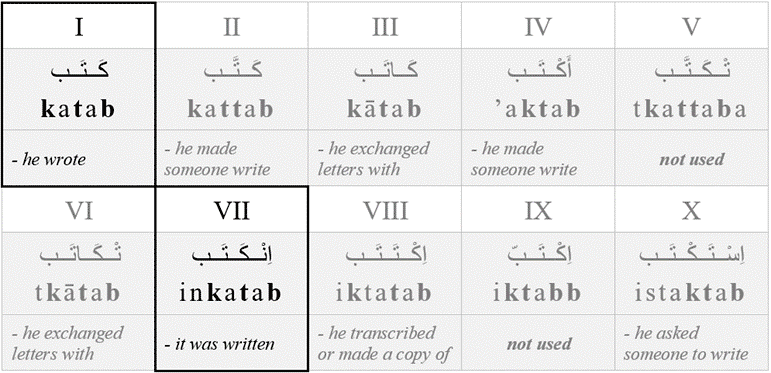
Notice the variety of meanings derived from the same triliteral root. Some forms, namely V and IX, are not found in dictionaries.
In Palestinian-Jordanian Arabic, Form I كَـتَـب (katab) ‘he wrote’ is the most commonly used, followed by Form VII اِنْــكَــتَــب (inkatab) ‘it was written,’ which conveys the passive voice meaning.
Other forms are scarcely used in Palestinian-Jordanian Arabic and are largely absent even from formal MSA writing, appearing almost exclusively in dictionaries and lexical references.
Note that these observations apply only to this specific triliteral root. Other triliteral roots may have different usage maps. Some may not even use Form I in written or spoken language. Only consistent practice can help you recognize commonly used forms in written and spoken Arabic.
2. Verb forms derived from the triliteral root ش – ر – ب (sh-r-b).
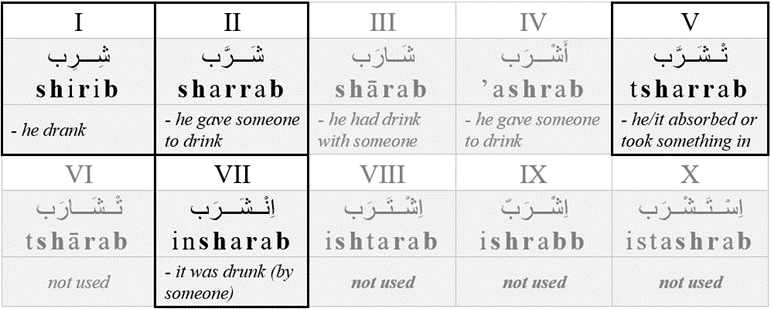
The usage map of past verbs derived from the tri-consonantal root ش – ر – ب (sh – r – b) is as follows:
- Form I is the most commonly used in daily life.
- Forms II, V, and VII are used but are less common.
- Forms III and IV are rarely used even in formal MSA.
- Forms VI, VIII, IX, and X are not found in dictionaries.
3. Verb forms derived from the triliteral root ك – ب – ر (k-b-r).
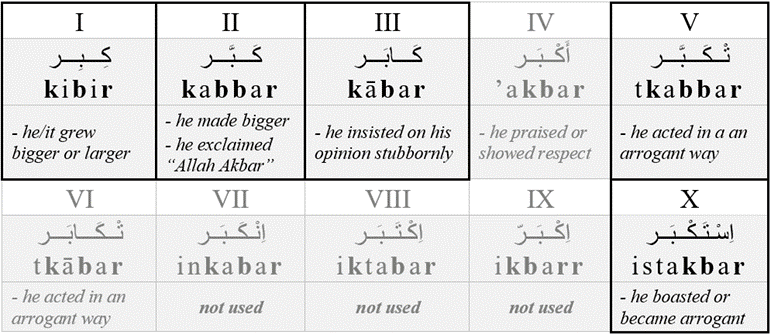
The usage map of past verbs derived from the tri-consonantal root ك – ب – ر (k – b – r) is as follows:
- Form I is the most commonly used in daily life.
- Forms II, III, V, and X are also used in daily life.
- Forms IV and VI are not often used in daily life but can be found in formal MSA.
- Forms VII, VIII, and IX are not found in dictionaries.
Remember that derived forms follow the same verb conjugation rules discussed earlier. Here are some examples:
| .تْــشَــرَّبَــت اِلْأَرْض اِلْــمَــيّ tsharrabat il-’arḍ il-mayy The land absorbed the water. |
| .اِسْـتَـكْـبَـرُوْ كْــثِــيْــر عَـلَـى صْــحَــابْــهُــمْ istakbaru kthīr ‘ala ṣḥābhum They became very arrogant with their friends. |
Quadri-literal Past Verbs
Most verbs in Arabic have tri-consonantal roots, while only a few have quadri-consonantal roots. We will examine the shortest past verb form for quadri-consonantal roots, فَــعْــلَــل (fa‘lal), as well as the most common derived form of the same root, تْــفَــعْــلَــل (tfa‘lal), which is often used as the passive voice of the base form.
Here are some examples:
| فَــعْــلَــل fa‘lal | تْــفَــعْــلَــل tfa‘lal |
| تَــرْجَــم tarjam he translated | تْــتَــرْجَــم ttarjam it was translated |
| دَبْــلَــج dablaj he dubbed (e.g., a film) | تْــدَبْــلَــج tdablaj it was dubbed (e.g., a film) |
| بَــرْمَــج barmaj he programmed | تْــبَــرْمَــج tbarmaj it was programmed |
| زَلْــزَل zalzal he shook violently | تْــزَلْــزَل tzalzal it was shaken violently |
Quadri-literal root verbs and their derived forms follow the same conjugation rules as tri-literal verbs.
| .اِلْــوَرَقَــة تْــتَــرْجَــمَــت مِـــن زَمَـــان il-waraqah (i) ttarjamat min zamān The paper was translated a long time ago. |
| .أَخُـــوْي وصَــاحْــبُــه بَــرْمَــجُــوْ الــتِّــلْــفِــزْيُــون ’akhūy u- ṣāḥbuh barmaju -t-tilfizyown My brother and his friend programmed the television. |
Back to: Demonstrative Pronouns
Other lessons in Level II: