




In MSA, a single definite article is used for all genders and numbers. The definite article in MSA is اَلْـ (al), which is equivalent to the definite article ‘the’ in English. In Palestinian-Jordanian dialects, the definite article is pronounced اِلْـ (il). If the word starts with two adjacent consonants, the definite article is pronounced لِـ (li) to avoid a consonant cluster.
Nouns preceded by the definite article are called definite nouns, whereas nouns not preceded by the definite article are called indefinite nouns. Below are some examples:
| Indefinite Nouns | Definite Nouns | ||
| mosque | مَــسْـجِـد masjid | the mosque | اِلْــمَـسْـجِـد il-masjid |
| moon | قَــمَــر qamar | the moon | اِلْــقَــمَــر il-qamar |
| book | كْــتَــاب ktāb | the book | الِــكْــتَــاب li-ktāb |
| mirror | مْـرَايِـة mrāyeh | the mirror | الِــمْـرَايِـة li-mrāyeh |
Arabic has no indefinite article; nouns are indefinite when not preceded by the definite article.
The definite article اِلْـ (il) always begins with a هَـمْـزَة وَصْـل (hamzat waṣl) ‘connecting hamzah,’ which is written without a ء (hamzah), i.e., ا (i). The ا (i) in اِلْـ (il) is not pronounced as a glottal stop in flowing speech. Instead, the sound is elided, connecting the لـ (l) in اِلْـ (il) directly to the preceding sound. For example:
| الِـكْـتَـاب واِلْـقَـلَــم li-kitāb w-il-qalam the book and the pen | شَــكْــل اِلْــقَــمَــر shakl il-qamar the shape of the moon |
Sun Letters vs. Moon Letters
In Arabic, the word for ‘sun’ is شَـمْـس (shams), and the word for ‘moon’ is قَـمَـر (qamar). When we add the definite article الـ (il) ‘the,’ we expect to write اِلْـشَـمْـس (il-shams) and اِلْـقَـمَـر (il-qamar).
However, while اِلْـقَـمَـر is written as expected and pronounced /il-qamar/, اِلـشَّـمْـس is written with a شَــدَّة (shaddah) on the ـشَّـ (sh) and pronounced /ish–shams/. This means that the لـ (l) in the الـ (il) is written but not pronounced, and the following letter is stressed in pronunciation due to the شَــدَّة (shaddah).
Therefore, we classify the letter ش (sh) as a sun letter and the letter ق (q) as a moon letter, based on how the two words شَـمْـس (shams) and قَـمَـر (qamar) are pronounced differently when the definite article is added.
Another meaningful name of sun letters is ‘assimilating letters,’ whereas moon letters can be called ‘non-assimilating letters.’
All Arabic consonants are classified as either sun (assimilating) or moon (non-assimilating) letters, meaning they behave either like the word شَـمْـس (shams) ‘sun’ or قَـمَـر (qamar) ‘moon’ when preceded by the definite article. There are 14 sun letters and 13 moon letters in Palestinian-Jordanian Arabic.
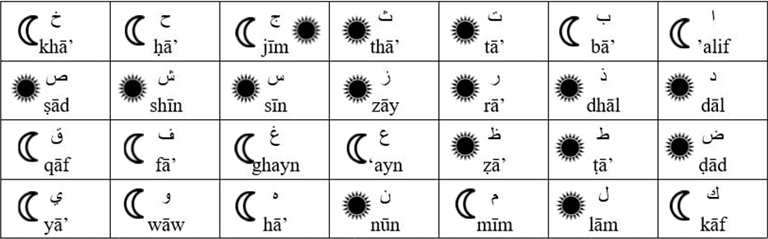
Note that the letter ج (j) is a moon letter in MSA. In most Palestinian-Jordanian dialects, however, the letter ج (j) is often treated as a sun letter. We will follow the Palestinian-Jordanian pronunciation throughout the book.
Here are some examples of sun letters versus moon letters:
| AR | Romanized | EN | Starts with sun/moon letter |
| اِلْــبَــقَــرَة | il-baqarah | the cow | ب (b) is a moon letter |
| اِلْــعِــيــن | il-‘eyn | the eye | ع (‘) is a moon letter |
| اِلـتِّـمْـسَـاح | it-timsāḥ | the crocodile | ت (t) is a sun letter |
| اِلـطَّـرِيْــق | iṭ-ṭarīq | the road | ط (ṭ) is a sun letter |
| اِلــنُّـــوم | in-nowm | the sleep | ن (n) is a sun letter |
Note that when the definite article is followed by a consonant cluster, it becomes لِـ (li). If the noun starts with a sun letter, both الـ (il) and الِـ (li) can be heard by Palestinian and Jordanian speakers.
| AR | Romanized | EN | Starts with sun/moon letter |
| الِــكْــتَــاب | li-ktāb | the book | ك (k) is a moon letter |
| اِلــنّْــجُــوْم الِــنْــجُــوم | in-njūm li-njūm | the stars | ن (n) is a sun letter |
| اِلــسّْــلَاح الِــسْــلَاح | is-slāḥ li-slāḥ | the weapon | س (s) is a sun letter |
Let us consider further examples using country names. Some country names are preceded by the definite article whereas others are not.
Below are some examples of countries that are preceded by the definite article. Some of them start with a sun letter, whereas others start with a moon letter. Notice the difference in pronunciation.
| AR | Romanized | EN | Sun/Moon letter |
| اِلْأَرْجَـنْـتِـيْـن | il-’arjantīn | Argentina | ا (’) is a moon letter |
| اِلْأرْدُن | il-’urdun | Jordan | ا (’) is a moon letter |
| اِلْبَـحْـرِيـن | il-baḥreyn | Bahrain | ب (b) is a moon letter |
| اِلْــبَــرَازِيْــل | il-barāzīl | Brazil | ب (b) is a moon letter |
| اِلْــبِــيْــرُو | il-bīru | Peru | ب (b) is a moon letter |
| اِلــجَّــزَائِــر | ij-jazā’ir | Algeria | ج (j) is a sun letter |
| اِلــدِّنْــمَـارْك | id-dinmārk | Denmark | د (d) is a sun letter |
| اِلــسُّـــوْدَان | is-sūdān | Sudan | س (s) is a sun letter |
| اِلـسَّــنِـغَـال | is-sanighāl | Senegal | س (s) is a sun letter |
| اِلـصُّـــوْمَــال | iṣ-ṣūmāl | Somalia | ص (ṣ) is a sun letter |
| اِلـصِّــيْــن | iṣ-ṣīn | China | ص (ṣ) is a sun letter |
| اِلْـعِــرَاق | il-‘irāq | Iraq | ع (‘) is a moon letter |
| الِـكْــوِيــت | li-kweyt | Kuwait | ك (k) is a moon letter |
| اِلْـمَـغْـرِب | il-maghrib | Morocco | م (m) is a moon letter |
| اِلْـمِـكْـسِـيْـك | il-miksīk | Mexico | م (m) is a moon letter |
| اِلْـهِـنْــد | il-hind | India | ه (h) is a moon letter |
| اِلْوِلَايَاتْ اِلْمُتَّحِدِة† | il-wilāyāt il-muttaḥideh | United States | و (w) is a moon letter |
| اِلْـيَـابَـان | il-yābān | Japan | ي (y) is a moon letter |
| اِلْــيَــمَــن | il-yaman | Yemen | ي (y) is a moon letter |
| اِلْـيُــونَــان | il-yownān | Greece | ي (y) is a moon letter |
† Note that most Arabs refer to the USA as أَمْــرِيْــكَــا (’amrīka) ‘America.’
Note that Arabic does not have a “p” sound. As a result, the letter ب (b) is used to approximate the “p” sound in اِلْــبِــيْــرُو (il-bīru) ‘Peru.’ Similarly, while the “g” sound in “Senegal” is found in many Arabic dialects, it is absent in MSA and is typically represented by the letter غ (gh).
Uses of the Definite Article in Arabic versus English
There are cases in which Arabic uses the definite article when in English, it would be omitted, such as:
1. Abstract concepts or speaking in a general sense. For example:
| .اِلْــعَــدْل مَــطْــلُــوْب il-‘ad(i)l maṭlūb Justice is required. | .اِلْـحَـيْـوَانَـات ذَكِـيِّـة il-ḥaywānāt dhakiyyeh Animals are intelligent. |
2. Days of the week. For example:
| .وِصِـل اِلــسَّــبِــت wiṣil is-sabit He arrived on Saturday. | رُحْــت اِلْـخَـمِـيْـس؟ ruḥt il-khamīs Did you go on Thursday? |
3. Before a personal title. For example:
| .اِلـدُّكْــتُــور أَحْــمَــد مِــش هُــون id-duktowr aḥmad mish hown Dr. Ahmad is not here. | وِيــن اِلـسَّـيِّــد خَـالِــد؟ weyn is-sayyid khālid Where is Mr. Khaled? |
This rule does not apply when addressing the person directly. For example:
| دُكْــتُــور أَحْــمَــد، وِيــنَــك؟ duktowr aḥmad weynak Dr. Ahmad, where are you? | سَـيِّـد خَـالِـد، كِــيْـفَــك؟ sayyid khālid kīfak Mr. Khaled, how are you? |
4. Before each noun in the case of multiple nouns. For example:
| اِلْأَبُــو واِلْإِمّ il-’abu w- il-’imm the father and mother | اِلْـبِــسَــس والِـكْــلَاب il-bisas u- li-klāb the cats and dogs |
5. Nationalities and demonyms. For example:
| .اِلْــمَــصْــرِيِّــيْــن طَــيّْــبِــيْــن il-maṣriyyīn ṭayybīn Egyptians (are) kind. | .اِلْـغَــزَّاوِيِّــة كُــرَمَــا il-ghazzāwiyyeh kurama Gazans (are) generous. |
Back to: Word Patterns in Arabic
Other lessons in Level II: