



In Palestinian-Jordanian Levantine Arabic, there are general rules to determine which syllable of a word is stressed. In this lesson, we discuss theses rules as well as examples to apply syllable stress in Arabic words.
Word Spelling
To spell a word in Arabic, you must recognize its consonants and vowels, then write them separately. Here are some examples:
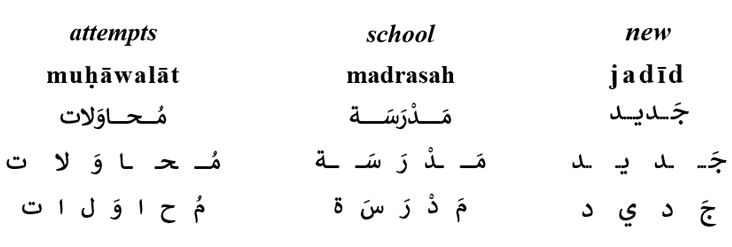
Syllable Stress in Arabic
We have seen that the three long vowels are prolonged versions of the three corresponding short vowels. Thus, syllables with long vowels (long syllables) are stressed more than the syllables with short vowels (short syllables).
For example, we can break a word like مُـحـاوَلات (muḥāwalāt) ‘attempts’ into four syllables: /mu/, /ḥā/, /wa/, and /lāt/. The word has two short syllables: /mu/ and /wa/, and two long syllables: /ḥā/ and /lāt/.
In most varieties of spoken Arabic, there are regional differences that determine which syllable of a word is stressed. However, in Standard Arabic, the following two rules are generally followed:
1. If the word contains one or more long syllables, the stress falls on the long syllable closest to the end of the word. If the last syllable is long but does not end with a consonant, it is treated as a short syllable.
2. If the word contains no long syllables and all syllables are short, the stress falls on the third-to-last syllable. If the word contains fewer than four syllables, the stress falls on the first syllable.
Let us start with the first rule. Below are some examples of words that contain one or more long syllables, with the stressed syllable in bold:
| كْــتَــابْــنَــا | ktāb-na | our book | The first long syllable from the end is /ktāb/. † |
| مُـحـاوَلات | mu-ḥā-wa-lāt | attempts | The first long syllable from the end is /lāt/. |
| مُــسَـاعَـــدِة | mu-sā-‘a-dah | help | The first long syllable from the end is /sā/. |
On the other hand, words that contain only short syllables follow the second rule. Words with fewer than four syllables stress the first syllable. Below are some examples of words that contain only short syllables:
| مَـسْـجِـد | mas-jid | mosque | The word has fewer than four syllables, so we stress the first syllable: /mas/. |
| الــقَــمَــر | al-qa-mar | moon | The word has fewer than four syllables, so we stress the first syllable: /qa/.* |
| مُـسْـتَـقْـبَـل | mus-taq-bal | future | The word has fewer than four syllables, so we stress the first syllable: /mus/. |
| اِسْـتَـقْــبَــلَـهُـم | is-taq-ba-la-hum | he received them | The third-to-last syllable is /ba/. |
| أَكَــلُــو | ’a-ka-lu | they ate | The word has fewer than four syllables, so we stress the first syllable: /’a/.† |
† The final لُــوْ (lū) is treated as short (lu) because it is the last long syllable but does not end with a consonant.
These are general rules, which may vary with regional dialects and accents. Therefore, practicing these rules is recommended, but do not worry if slight deviations occur.
Consonant Clusters in Palestinian-Jordanian Arabic
In Palestinian-Jordanian Arabic, consonants can appear in clusters of two within a word. Clusters of three or more are generally avoided.
| مَـــسْـــجِـــد masjid mosque | مُـــسْـــتَـــقْـــبَـــل mustaqbal future |
| مَـــدْرَسِـــة madraseh school | اِلْـــقَـــمَـــر il–qamar the moon |
Even a two-consonant cluster at the end of a word is often broken up by inserting a short vowel (“i” or “u”). In general, if the preceding vowel is “i” or “u,” the same short vowel is inserted to break up the final consonant cluster. If the preceding vowel is “a,” most words take “i,” though a few take “a.”
| جِـــسْـــر ← جِـــسِـــر jis[i]r ← jisr bridge | غُــــصْـــن ← غُــــصُـــــن ghuṣ[u]n ← ghuṣn branch |
| قَـــبْـــل ← قَـــبِـــل qab[i]l ← qabl before | بَـــحْـــر ← بَـــحَـــر baḥ[a]r ← baḥr sea |
Not all words follow this rule. Some words end with a two-consonant cluster that is not broken up with a short vowel. For example:
| عِــــنْــــد ‘ind at | كَــــــرْت kart card | اِلْـــهِــــنْــــد il-hind India |
Keep in mind that this vowel insertion in the final two-consonant cluster of words in Palestinian-Jordanian Arabic only applies at the end of speech or a sentence. It often does not apply in the middle of speech if the next word begins with a vowel.
| جـــسْـــر اِلْــمُــشَــاة jisr il-mushāh pedestrian bridge | غُــــصْـــن اِلــشَّـــجَـــرَة ghuṣn ish-shajarah tree branch |
| قَـــبْـــل اِلــنُّــــوم qabl in-nowm before bed | اِلْــبَـــحْـــر اِلْــمِــيِّــت il-baḥr il-miyyit the Dead Sea |
This process of vowel insertion makes the pronunciation smoother and is a regular feature of Palestinian-Jordanian Arabic phonology. Breaking the final two-consonant cluster is a general rule that you should keep in mind to help you understand the spoken dialect. However, you do not have to follow this rule meticulously as you learn how to speak Palestinian-Jordanian Arabic.
ﷲ (Allāh) Ligature in Arabic
The Arabic word for God is الـلّـٰـه (Allāh), which is believed to be a contraction of the definite article الْـ (al) ‘the’ followed by the word for a god, إِلـٰــه (’ilāh). The resulting word, الْإِلـٰــه (al-’ilāh) ‘the god,’ is believed to be the source of the word الـلّـٰـه (Allāh) ‘God.’
The word الـلّـٰـه (Allāh) is used by both Muslim and non-Muslim Arabs, and by many non-Arab Muslims worldwide. Cognates of the word الـلّـٰـه (Allāh) exist in other Semitic languages, such as Aramaic (’Ĕlāhā), Syriac (’Alāhā), and Hebrew (’Ĕlōah).
The Arabic letter ل (lām) ‘l’ represents a light ‘l’ sound, pronounced with the tip of the tongue gently touching the alveolar ridge (just behind the upper teeth). However, in الـلّـٰـه (Allāh), the ل (lām) ‘l’ is uniquely pronounced with a stronger, more emphatic sound, somewhat closer to the English ‘l.’ Additionally, the ‘long ā’ vowel is pronounced with an open, broad sound, resembling the “a” in “father.”
Notice the short vertical stroke ـــٰــ above ل (lām) ‘l’ in the words إِلــٰــه (’ilāh) ‘god’ and الـلّـٰـه (Allāh) ‘God.’ This stroke is called أَلِـف خِـنْـجَـرِيَّـة (’alif khinjariyyah) ‘dagger ’alif,’ and it marks the presence of a ‘long ā’ vowel.
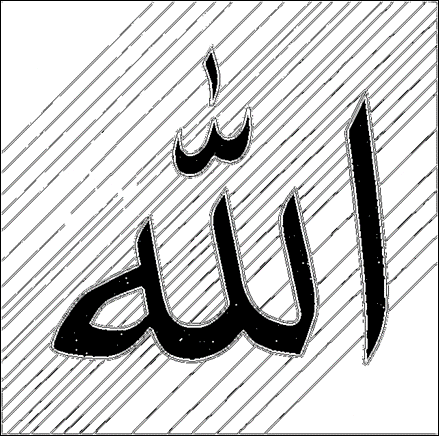
Arabic calligraphy of the word (Allāh) ‘God’
In the Quran, the use of the dagger ’alif is more common. Nevertheless, there are only a few other words in Standard Arabic that use the dagger ’alif, which is often omitted in writing. Most people recognize that these few words contain a ‘long ā’ vowel. Here are some common examples:
| إِسْــحَـٰـق ’is-ḥāq Isaac | لـٰـكِـن lākin but | *الـرَّحْـمـٰـن ar-raḥmān The Most Merciful |
* One of the divine names of God in Islam
Other lessons in Level I: