
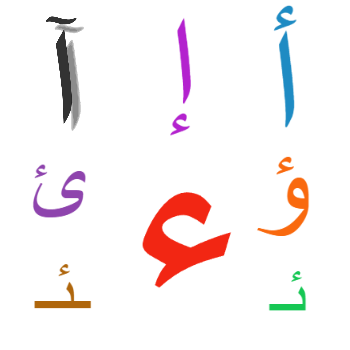
Mastering Arabic Hamzah orthography is a significant milestone for any student of Arabic. The “seat” (or Kursi) of the Hamzah (ء)—whether it sits on an ’alif, wāw, or yā’—is often seen as one of the script’s most complex challenges. The placement of this glottal stop is governed by the letter’s position in a word and the interaction between surrounding vowels. In this step-by-step guide, we break down the definitive rules for initial, final, and medial Hamzah, including the essential “vowel strength hierarchy” used to determine the correct spelling every time. Whether you are a beginner or looking to perfect your academic writing, this comprehensive tutorial will help you navigate Arabic Hamzah orthography rules with confidence and precision.
Arabic Hamzah Forms & Placement
The هَـمْـزَة (hamzah) in Arabic can appear in various forms:
1. On top of an ’alif (أ), wāw (ؤ), or yā’ (ئ , ئـ , ـئـ).
2. Under an ’alif (إ).
3. On a horizontal line (ء).
The placement of the hamzah is influenced by three main factors:
1. Its position in the word: beginning, middle, or end.
2. The vowel marking the hamzah itself.
3. The vowel marking the letter before the hamzah.
Initial Hamzah Orthography Rules
When hamzah is the initial consonant of a word, its orthography is determined solely by the vowel marking the hamzah itself.
| Vowel Mark on Initial Hamzah | Hamzah Placement | Example |
| فَــتْــحَــة fatḥah short a | أ | أَحْــمَــد ’aḥmad Ahmad |
| مَــدّ أَلِــف madd ’alif long ā | آ | آمــيــن ’āmīn Amen |
| ضَــمَّــة ḍammah short u | أ | أُمّ ’umm mother |
| مَــدّ واو madd wāw long ū | أولــى ’ūlā first | |
| كَــسْــرَة kasrah short i | إ | إِذا ’idhā if |
| مَــدّ يــاء madd yā’ long ī | إيــران ’īrān Iran |
Note that hamzat al-madd آ (’ā) is a special case that represents a hamzah sound followed by a ‘long ā’ vowel. It is used to avoid writing two consecutive ’alif letters, i.e., أا.
Final Hamzha Orthography Rules
When hamzah is the final consonant of a word, its orthography is determined solely by the vowel marking the letter before the hamzah.
| Vowel Mark on Letter Before Final Hamzah | Hamzah Placement | Example |
| فَــتْــحَــة fatḥah short a | أ | أَبْـدَأُ ’abda’u I begin |
| ضَــمَّــة ḍammah short u | ؤ | تَـواطُـؤ tawāṭu’ complicity |
| كَــسْــرَة kasrah short i | ئ | قــارِئ qāri’ reader |
| مَــدّ أَلِــف madd ’alif long ā | ء | *سَــمَــاْء samā’ sky |
| مَــدّ واو madd wāw long ū | *هُـــدُوْء hudū’ calmness | |
| مَــدّ يــاء madd yā’ long ī | *بَـــرِيْء barī’ innocent | |
| سُــكــون sukūn no-vowel | مِـــلْء mil’ fullness |
* Note that the long vowel is marked with سُـكـون (sukūn). Note that the vowel marking the final hamzah itself—often influenced by the word’s syntactic role in the sentence—does not affect the orthography of the hamzah.
Medial Hamzah Orthography Rules
When the hamzah occurs in the middle of a word, its orthography is determined by two vowels:
- The vowel marking the hamzah itself.
- The vowel marking the letter before the hamzah.
In general, the hamzah is written based on the stronger vowel, whether this vowel appears on the hamzah itself or the preceding letter.
The vowels, in order of strength, are as follows:
| Strongest | ↔ | Weakest | |
| كَــسْــرَة kasrah short i | ضَــمَّــة ḍammah shortu | فَــتْــحَــة fatḥah short a | سُــكــون sukūn no-vowel |
Notice that we will mark all letters in each word, including long vowels, which are marked with سُـكـون (sukūn).
The medial hamzah is written as follows:
| ـئـ | – When the stronger vowel is كَـسْـرَة (kasrah) ‘short i.’ – When the hamzah is preceded by يْ (yā’ marked with sukūn). |
| ؤ | – When the stronger vowel is ضَـمَّـة (ḍammah) ‘short u.’ |
| أ | – When the stronger vowel is فَـتْـحَـة (fatḥah) ‘short a,’ and the hamzah is preceded by فَـتْـحَـة (fatḥah) or سُـكـون (sukūn) that is not a long vowel. |
| ء | – When the stronger vowel is فَـتْـحَـة (fatḥah) ‘short a,’ and the hamzah is preceded by سُـكـون (sukūn) that is a long vowel. – When the hamzah is preceded by وْ (wāw marked with sukūn). |
Here are some examples with medial Hamzah following Arabic Hamzah orthography rules:
| Hamzah Placement | Example | |
| ـئـ | قَــاْئِــد qā’id leader | خَــطِــيْــئَــة khaṭī’ah sin |
| لَــئِــيْــم la’īm mean | يَــيْــئَــس yay’as he despairs | |
| ؤ | تَــفَــاْؤُل tafā’ul optimism | †شُـــؤُوْن shu’ūn affairs |
| مُــؤْسِــف mu’sif regrettable | سُـــؤَاْل su’āl question | |
| أ | سَـــأَلَ sa’ala he asked | مَــسْــأَلَــة mas’alah issue’ |
| فَـــأْر fa’r mouse | جُــرْأَة jur’ah boldness | |
| ء | قِـــرَاْءَة qirā’ah reading | *تَـــوْءَم taw’am twin |
| مُــرُوْءَة murū’ah chivalry | ضَــوْءُه ḍaw’uh his light | |
† It is also acceptable to write ــؤو as ــئـو in شُـؤُوْن, i.e., شُـئـون.
* It is also acceptable to write تَـوْءَم as تَـوْأَم.