
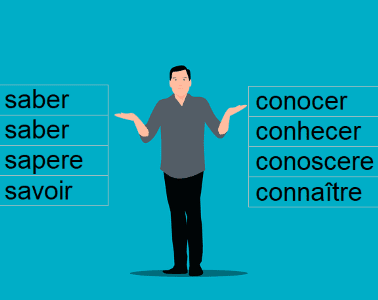
In Spanish, Portuguese, Italian, and French, there are two verbs that mean “to know.” These verbs are: “saber” and “conocer” in Spanish, “saber” and “conhecer” in Portuguese, “sapere” and “conoscere” in Italian, and “savoir” and “connaître” in French.
| Spanish | saber | conocer |
| Portuguese | saber | conhecer |
| Italian | sapere | conoscere |
| French | savoir | connaître |
Ah, two ever-confusing sets of verbs! Both translate to “to know” in English, but using the wrong one can leave your audience bewildered. Fear not, language enthusiast! This guide will demystify these verbs, empowering you to express knowledge with confidence.
When to use “Saber” vs “Conocer”, “Saber” vs “Conhecer”, “Sapere” vs “Conoscere”, & “Savoir” vs “Connaître”
Knowing when to use each verb should not be difficult if you understand the subtle difference between the two concepts of “knowing.”
In short, the first set of verbs: “saber,” “sapere,” and “savoir” are used to describe knowledge of facts, concepts, skills, abilities, etc.
On the other hand, the second set of verbs: “conocer,” “conhecer,” “conoscere,” and “connaître” are used to describe recognition or familiarity with a person, a place, or an object, including a movie, a site, a brand, etc.
In Italian and French, when referring to a language, one could use either verb. The difference is that “Conosco l’italiano” indicates that you know some Italian or that you are familiar with the language, whereas “So l’italiano” or “So parlare l’italiano” indicates that you know Italian well enough to speak it. Similarly, “Je connais le français” indicates that you know some French or that you are familiar with the language, whereas “Je sais le français” or “Je sais parler français” indicates that you know French well enough to speak it.
Examples of “Saber” vs “Conocer”, “Saber” vs “Conhecer”, “Sapere” vs “Conoscere”, & “Savoir” vs “Connaître”
Here are some examples that use the two verbs and highlight the difference:
| Examples | Explanation | |
| EN | Do you know if there is someone inside? | When referring to a fact (whether someone is inside or not): use “saber,” “sapere,” or “savoir.” |
| SP | ¿Sabes si hay alguien dentro? | |
| PT | Você sabe se há alguém dentro? | |
| IT | Sai se c’è qualcuno dentro? | |
| FR | Sais-tu s’il y a quelqu’un à l’intérieur? | |
| EN | She doesn’t know how to swim. | When referring to a skill: use “saber,” “sapere,” or “savoir.” |
| SP | Ella no sabe nadar. | |
| PT | Ela não sabe nadar. | |
| IT | Lei non sa nuotare. | |
| FR | Elle ne sait pas nager. | |
| EN | I don’t know where there is a school. | When referring to a fact (whether a school exists nearby): use “saber,” “sapere,” or “savoir.” |
| SP | No sé dónde hay una escuela. | |
| PT | Não sei onde há uma escola. | |
| IT | Non so dove ci sia una scuola. | |
| FR | Je ne sais pas où il y a une école. | |
| EN | I don’t know the city very well. | When referring to recognizing a place: use “conocer,” “conhecer,” “conoscere,” or “connaître.” |
| SP | No conozco la ciudad muy bien. | |
| PT | Não conheço muito bem a cidade. | |
| IT | Non conosco molto bene la città. | |
| FR | Je ne connais pas très bien la ville. | |
| EN | They don’t know my parents. | When referring to recognizing a person: use “conocer,” “conhecer,” “conoscere,” or “connaître.” |
| SP | No conocen a mis padres. | |
| PT | Não conhecem meus pais. | |
| IT | Non conoscono i miei genitori. | |
| FR | Ils ne connaissent pas mes parents. | |
| EN | Do you know that movie? | When referring to recognizing a movie: use “conocer,” “conhecer,” “conoscere,” or “connaître.” |
| SP | ¿Conoces esa película? | |
| PT | Conhece aquele filme? | |
| IT | Conosci quel film? | |
| FR | Connaissez-vous ce film? | |
| EN | Do you know English? | When referring to a language, in Spanish and Portuguese: we use “saber,” “sapere,” or “savoir.” In Italian and French, either verb can be used. |
| SP | ¿Sabes inglés? | |
| PT | Sabe inglês? | |
| IT | Conosci l’inglese? (or) Sai l’inglese? | |
| FR | Connaissez-vous l’anglais? (or) Savez-vous l’anglais? |
Expressions that use “Saber,” “Sapere,” or “Savoir”
The verb “saber,” “sapere,” or “savoir” is used in many expressions, for example:
| SP | lo sé | I know | ¿quién sabe? | who knows? |
| PT | eu sei | quem sabe? | ||
| IT | lo so | chissà? | ||
| FR | je sais | qui sait? | ||
| SP | para que lo sepas | just so you know | que yo sepa | as far as I know |
| PT | para que saiba | que eu saiba | ||
| IT | perché lo sappia | per quanto ne so | ||
| FR | pour que tu le saches | que je sache1 |
To know each other
The verb “conocer,” “conhecer,” “conoscere,” or “connaître” is used to refer to the reciprocal act of knowing each other, for example:
| SP | Nos conocemos muy bien. | We know each other very well. |
| PT | Nos conhecemos muito bem. | |
| IT | Ci conosciamo molto bene. | |
| FR | Nous nous connaissons 2 très bien. | |
| SP | No se conocen. | They don’t know each other. |
| PT | Eles não se conhecem. | |
| IT | Non si conoscono. | |
| FR | Ils ne se connaissent pas. |
Referring to the Past
The verb “conocer,” “conhecer,” “conoscere,” or “connaître” can also mean “to meet” when referring to the past, for example:
| SP | Conocí a mi esposa en la universidad. | I met my wife at university. |
| PT | Conheci minha esposa na faculdade. | |
| IT | Ho conosciuto mia moglie all’università. | |
| FR | J’ai connu ma femme à l’université. |
To learn more about the difference between the two verbs and for more examples, refer to the following lessons: