Arabic is a rich and diverse language with several distinct spoken varieties. Understanding the differences between Classical Arabic, Modern Standard Arabic (MSA), and regional dialects is essential for anyone seeking to learn the language. Classical Arabic, rooted in the Quran and pre-Islamic poetry. MSA has evolved to include contemporary vocabulary while maintaining formal usage in media and education. Meanwhile, regional dialects, such as Egyptian, Levantine, and Gulf Arabic, offer variations in pronunciation and vocabulary, reflecting the cultural diversity of the Arabic-speaking world. Whether you’re studying Islam, engaging with modern media, or planning to live in an Arabic-speaking country, knowing which form of Arabic to learn is crucial for effective communication.
Table of Contents
- Arabic Language: Classical vs. Modern Standard vs. Regional Dialects
- Regional Dialects of the Arabic Language
- The Word كَـثـيـر (kathīr) ‘a lot’ as an Example
- Which Arabic Should I Learn?
- Conclusion
Arabic Language: Classical vs. Modern Standard vs. Regional Dialects
There are three types of Arabic:
1. Classical or Quranic Arabic
This is the Arabic from the 7th century in which the Quran was written. It is based on the medieval dialects of the Arab tribes of the time. Classical Arabic is the foundation upon which Modern Standard Arabic (MSA) is based.
The two share the same sentence structure and a significant amount of vocabulary. However, certain words may be used differently, and some punctuation and vocalization marks may also differ slightly. In many Arab and Muslim countries, learning to recite the Quran is part of a child’s education. Most Arabic speakers are familiar with both Classical and Modern Standard Arabic.
The Quran and pre-Islamic poetry are considered the standard of purity of the Arabic language. When tracing the etymology of an Arabic word, classical dictionaries are typically consulted first, often drawing upon examples from the Quran and pre-Islamic poetry.
2. Modern Standard Arabic (MSA)
This is the natural evolution of the Classical Arabic. It shares a lot of vocabulary with Classical Arabic, but adds to it a lot of today’s vocabulary, e.g., television, fridge, football, car, train, etc.
Modern Standard Arabic is used in formal settings, education, and non-entertainment media. When Arab politicians give speeches, they are more inclined to do so in MSA. If you tune into a pan-Arabic TV channel like Al Jazeera, MSA is used exclusively. Newspapers in any Arabic-speaking country are written in MSA and almost never in a local dialect.
Thus, it is important to learn MSA or at least have some foundation in it before learning any regional dialect. MSA is the means of communication that allows all Arabic speakers to understand each other, all the way from Morocco to Iraq.
3. Regional Dialects
Many linguists consider each of these Arabic regional dialects to be a language. Arabic dialects are treated much like unwritten languages. Arabic dialects can vary significantly in vocabulary and pronunciation. This gap between MSA and the language spoken in the street is referred to by linguists as diglossia.
According to the Oxford dictionary, diglossia is defined as “a situation in which two languages (or two varieties of the same language) are used under different conditions within a community, often by the same speakers. The term is usually applied to languages with distinct ‘high’ and ‘low’ (colloquial) varieties, such as Arabic.”
Regional Dialects of the Arabic Language
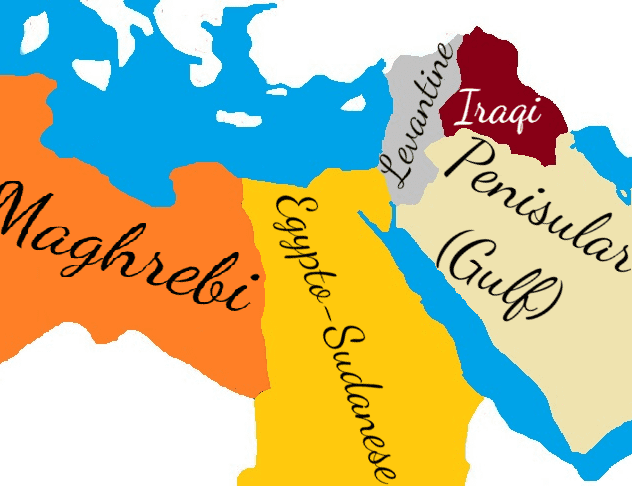
In the most common classification of today’s varieties of Arabic, people typically refer to five main groups of regional dialects: Peninsular (Gulf), Mesopotamian (Iraqi), Levantine, Egyptian (Egypto-Sudanese), and Maghrebi.
In general, there is a high mutual intelligibility between speakers of each of these five groups of dialects. The Egyptian dialect is widely understood by most Arabic speakers due to the broad reach and strong influence of Egyptian entertainment media across the Arab world.
This classification is a broad generalization. Many consider Yemeni dialects to be distinct from Peninsular (Gulf) dialects, and Sudanese dialects to be vastly different from Egyptian dialects. In addition, there are less-common varieties of Arabic, such as Hassaniya, Chadian, and Nubi.
The Word كَـثـيـر (kathīr) ‘a lot’ as an Example
Here is an example of the different ways Arabs say كَـثـيـر (kathīr) ‘a lot’ in some Arabic dialects:
| Palestine | Syria | Saudi Arabia | Iraq | Kuwait |
| كْـثـيـر kthīr | كْـتـيـر ktīr | مَــرَّه marrah | هْـوايَـة hwāyah | وايِـد wāyid |
| Egypt | Tunisia | Morocco | Libya | Sudan |
| أَوي ’awī | بَـرْشـا barshā | بَـزّاف bazzāf | هَـلْـبـا halbā | شِـديـد shidīd |
Which Arabic Should I Learn?
If you wish to deeply study Islamic texts in their original form, mastering Classical Arabic is essential. On the other hand, if you want to understand modern-day Arabic, knowing MSA basics is paramount to understanding written and non-entertainment media. If you are a tourist or want to move to an Arabic-speaking country, then your choice of regional dialect will depend on your destination. However, even if you want to move to an Arabic-speaking country, knowing the basics of MSA can be helpful.
Conclusion
The Arabic language offers a fascinating blend of historical depth and modern evolution. While Classical Arabic remains the foundation for religious texts and classical literature, Modern Standard Arabic serves as the unifying language for formal communication, media, and education across the Arab world. On the other hand, regional dialects of the Arabic language provide a vibrant and varied means of everyday communication, each with its unique characteristics shaped by geography and culture. Whether you’re pursuing academic study, professional communication, or travel, understanding the distinctions between these forms of Arabic will enhance your language learning journey and allow for richer interactions within the diverse Arab-speaking world.