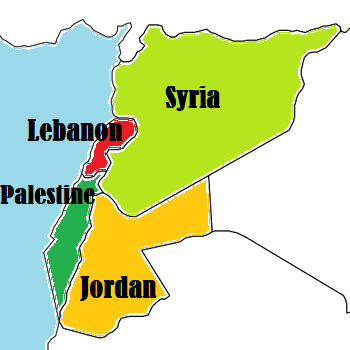
Levantine Arabic refers to the variety of Arabic dialects spoken in the Levant, namely Syria, Lebanon, Palestine, and Jordan. North Levantine Arabic is spoken primarily in Syria and Lebanon, whereas South Levantine Arabic includes speakers in Palestine and Jordan. Mutual intelligibility between North and South Levantine varieties is generally high, despite some linguistic differences.
Levantine Arabic Features
General characteristics of Levantine Arabic dialects include:
- The use of the ب (b) prefix as a verbal marker to form the present (imperfect) tense.
- The use of the particle رح (raḥ) or حَـ (ḥa-) before the present (imperfect) verb to form the future tense.
- The tendency to pronounce words ending with the feminine marker ة (tā’ marbūṭah) ‘tied-t’ as /-eh/, rather than the Modern Standard Arabic (MSA) pronunciation /-ah/.
- The pronunciation of the letter ق (qāf) ‘q’ in many words as a glottal stop, represented by (’), which sounds like the initial sound in “art,” “old,” or “inch,” without the following vowel. This is especially common in urban areas.
- The loss of gender distinction in the second- and third-person plurals of verbs and pronouns.
Note that there are many exceptions to these general rules. For example, the gender distinction in the second- and third-person plurals is retained in the dialects spoken in many Palestinian villages. In addition, minor vocalization differences exist among the various Levantine dialects. Nevertheless, most of these differences do not impede communication or mutual intelligibility.
Pronunciation of the Letter ق (qāf) in Levantine Arabic
The pronunciation of the letter ق (qāf) ‘q’ varies across the Levant. In Modern Standard Arabic (MSA), ق is a voiceless uvular plosive, a heavy and emphatic “k” sound produced by retracting the tongue to make contact with the uvula, rather than the velum (soft palate) as in the English “k” sound. It is often transliterated into English as “q,” e.g., قــطــر ‘Qatar.’
| Arabic Variety | Pronunciation of the letter ق | |
| MSA | q | voiceless uvular plosive |
| Urban | q → ’ | glottal stop, as in “art” |
| Rural Palestinian | q → k | voiceless velar plosive, as in “kangaroo” |
| Bedouin/Jordan | q → g | voiced velar plosive, as in “girl” |
| Druze & Alawite | q | voiceless uvular plosive |
The Druze and Alawite minorities stand out for maintaining the MSA pronunciation of the letter ق (qāf) ‘q.’ In rural areas of Palestine, it is pronounced like “k” in “kangaroo.” Among Bedouins and in most of Gaza, Naqab (Negev), Jordan, and the Syrian desert, it is pronounced like “g” in “girl.”
In urban cities of Palestine and the North Levant (Syria and Lebanon), ق (qāf) ‘q’ is pronounced in many words as a glottal stop, represented by (’), as in the initial sound of “art.”
Educated and religious speakers generally tend to retain the correct MSA pronunciation of the letter ق (qāf) ‘q.’
For beginners, the recommended approach is to adopt the MSA pronunciation of ق as a heavy, emphatic “k” sound while remaining aware of the other regional variations.
Final Words
Although the scarcity of reliable, well-organized resources for regional Arabic dialects—and the variations that exist even within the same country or province—pose a challenge, there is a silver lining: regional dialects typically use a more limited vocabulary compared to the extensive lexicon of Modern Standard Arabic.
Whether you’re pursuing academic study, professional communication, or travel, understanding the distinctions between Arabic dialects will enhance your language learning journey and allow for richer interactions within the diverse Arab-speaking world.